

Introduction
Anyone remember the old late 80’s commercial where an egg cracked into a frying pan was branded ‘your brain on drugs’? Well, if it aired today, the frying pan might be swapped for a laptop screen, captioned: ‘This is your brain on ChatGPT.’ It’s a funny thought, right? Scrambled brains and scrambled code but here’s where the joke ends.
Neuroscientists at MIT and Stanford are now finding that the way we use tools like ChatGPT may not just change how we work but could also reshape how our brains function. Early evidence suggests that overreliance on these systems can weaken memory, dull creativity, and erode focus. For busy professionals such as us, the risk isn’t theoretical. It’s the slow, silent cost of outsourcing too much of our thinking; a cost paid in reduced agility, shallower problem-solving, and missed opportunities to grow. The question isn’t whether we should use ChatGPT, but whether we’re using it as a tool to sharpen our minds, or as a crutch that lets them atrophy.
Your Brain on ChatGPT: What MIT Discovered
In June 2025, MIT researchers released a provocative paper titled Your Brain on ChatGPT, examining how reliance on generative AI alters neural activity during problem-solving (MIT Media Lab, 2025). Using EEG scans, the study compared brain activity in participants solving tasks independently versus those assisted by ChatGPT.
At the time of this writing, the MIT paper is a preprint on arXiv, which means it has not yet undergone peer review. Its results should be treated as preliminary signals rather than definitive conclusions. Still, the early findings are eye-opening: participants relying on ChatGPT showed reduced activation in regions linked to working memory and deep cognitive effort. In simple terms, the brain has started outsourcing some of the heavy lifting.
The researchers describe this as the accumulation of “cognitive debt” — a phenomenon where repeated reliance on AI may gradually weaken the very faculties professionals depend on most.
Lessons from Digital Cognition Research
This warning isn’t happening in isolation. A 2023 mini-review in Frontiers in Cognition found that digital tools; from AI to social media consistently shape our core cognitive processes (Shanmugasundaram & Tamilarasu, 2023). Attention, decision-making, and memory are particularly vulnerable to these maladaptive patterns of overuse.
So what’s the nuance? These effects aren’t inherently harmful. Just as physical exercise can strengthen or strain the body depending on form, digital tools can sharpen or dull the mind depending on use. The review emphasizes intentionality: structured engagement builds adaptive cognitive flexibility, while passive or distracted use erodes it.
Multitasking Minds: Stanford’s Classic Warning
Years before ChatGPT, Stanford researchers raised a red flag. In 2009, Eyal Ophir, Clifford Nass, and Anthony Wagner published Cognitive 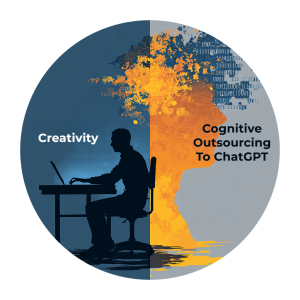 Control in Media Multitaskers in PNAS (Ophir et al., 2009). Their findings: heavy media multitaskers struggled significantly more with filtering distractions and recalling details compared to light multitaskers.
Follow-up work from Stanford’s Memory Lab has reinforced the point: multitasking with digital media reduces working memory performance. ChatGPT, when used reflexively, risks becoming another stream of distraction. Instead of focusing deeply, professionals may bounce between prompts and outputs; a kind of digital channel-surfing that chips away at sustained attention.
TikTok, ChatGPT, and the Cost of Context Switching
One of the strongest parallels comes from a 2023 study presented at the ACM CHI Conference. Researchers Chiossi, Rodil, and Goncalves investigated how short-form video feeds (like TikTok) impact prospective memory; the ability to remember tasks we intend to do (Chiossi et al., 2023). Their results were striking: participants who consumed TikTok-style feeds had significantly lower prospective memory performance compared to those watching YouTube, scrolling Twitter, or in a controlled condition.
Yes Yes, ChatGPT is not TikTok but the mechanism is similar. Rapid prompting, skimming responses, and context-switching between tasks can produce a fragmented mental state. The danger is subtle: we may not notice until we forget the very intention that brought us to the tool in the first place.
Beyond the Brain: Holistic Growth in the Digital Era
The science is compelling, but TAP’s perspective insists on a broader view. Professionals are more than their cognitive outputs; growth is holistic, touching mind, body, and soul. Here’s a few methods to better balance our holistic growth.
- Mind: Use Agile principles like timeboxing and WIP (work-in-progress) limits when working with ChatGPT. Treat prompts like sprint tasks — focused, intentional, closed before moving on.
- Body: Balance digital engagement with embodied breaks with a nod towards Pomodoro like techniques. A short walk, stretches, or even breathwork counteracts the inertia of screen time and resets cognitive load.
- Soul: Let ChatGPT inspire, but not replace. For example, ask it for creative prompts, but then sketch, write, or brainstorm offline. Creativity is nurtured in the space between input and reflection.
By aligning digital practices with holistic habits, professionals can guard against erosion while reclaiming the upsides of innovation.
Navigating the “It’s Complicated” Relationship
Like any modern relationship, our bond with ChatGPT is complicated. It offers immense possibility, yet it carries hidden costs if unexamined. The duality is subtle yet clear:
- ChatGpt as our Clever Partner: It’s a tool for efficiency, idea generation, and democratizing access to knowledge.
- ChatGpt as our Cognitive Crutch: A risk when it replaces deep thought, memory practice, or creative struggle.
For Diverse Talent professionals, the key lies in intentional use. The challenge is not to reject the tool, but to shape habits where ChatGPT sharpens focus rather than dulls it.
In Conclusion
The story of When Brain Met ChatGPT is not a rom-com, but it does carry a relational lesson: growth requires boundaries. Used wisely, ChatGPT can serve as a catalyst for sharper thinking, broader access, and professional creativity. Used passively, it risks becoming the silent thief of focus.
Worth Discussing? This conversation isn’t just about technology; it’s about the future of our minds. How we use ChatGPT today will shape not only what we know tomorrow, but how we know it.
